
Sucralose is an artificial sweetener commonly known by the name Splenda.
It tastes pretty much like sugar and is now used in products and marketed to people for weight loss, diabetes, and overall health benefits.
But is sucralose good for you?
That’s an interesting question and after I recently wrote an article about the best sugar substitutes for diabetics, someone asked if sucralose was okay so I thought I’d write an article with some more info about it because it is up for debate.
Sucralose in the Body
It has been proposed that sucralose in humans is not metabolized and is mostly unabsorbed and excreted in the faeces, with the remainder being excreted via the urine. The amount of absorption varies between individuals, humans absorbing approximately 15%. And some studies suggest that there is no accumulation of sucralose in the body over time, but this has recently been proven otherwise (as we’ll explore below).
Safety of Sucralose
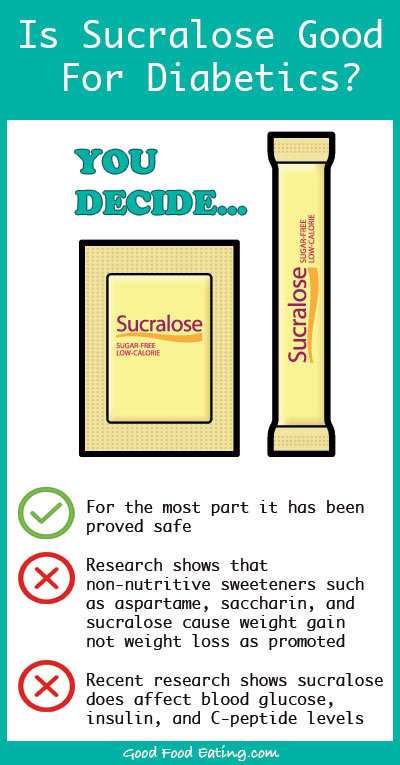
It’s true that sucralose has been widely studied for it’s toxicity and for any adverse effects and for the most part it does appear safe. Even In studies where healthy humans were given excessive doses no adverse effects were recorded.
However there are a couple of studies that show otherwise and raise some questions.
In one study rats were fed Splenda for 12 weeks and had a significant decrease in beneficial gut bacteria and subsequent weight gain, even at low doses approved by the FDA for human consumption. This is not great because changes in gut bacteria will increase inflammation, and as shown with the rats, other studies have shown links between changes in gut bacteria and weight gain.
One side effect is that sucralose may trigger migraine and headaches.
And another also pointed out its safety because changes in gut bacteria and intestinal permeability have been noted.
These controversial studies are often met with high opposition from Splenda, which is no surprise considering sucralose is contained in more than 4000 products. This means there would be massive ramifications to the food industry and this company’s bottom line if this non-nutritive sweetener were removed from production, much like aspartame.
Sucralose and Blood Glucose
It’s true that in ‘most’ clinical trials sucralose shows no effect on blood glucose and insulin response and this does suggest that it is safe for diabetics. However there are a couple of things that suggest otherwise.
There is evidence to suggest that non-nutritive sweeteners like aspartame, saccharin, and sucralose increase weight gain and metabolic syndrome. Researchers from Purdue University have clearly demonstrated this fact.
One group of researchers (Pepino et al.) in a more recent study showed that sucralose DOES alter the metabolic response in insulin sensitive obese people. So sucralose DOES effect glycemic response and sucralose DOES exert a metabolic effect. I did point out above that studies show there is no accumulation of sucralose in the body over time, however this study showed that sucralose may in fact have a cumulative effect over time.
Most studies done with sucralose do not exclude people who regularly consume sucralose and so Pepino et al. proposed that regular consumption has an overall effect on glucose metabolism that may blunt the effects of sucralose intake. So Pepino et al. took insulin resistant obese subjects who did not use sucralose and put them through a study.
In their study subjects showed:
- Higher peak blood glucose after sucralose intake
- Higher peak insulin levels after sucralose intake
- Higher C reactive protein (a pro-inflammatory marker) after sucralose intake
- Decreased insulin clearance from consuming sucralose
Therefore this study showed that sucralose DOES alter the metabolic response, and may have an accumulative effect that has not yet been studied.
So is Sucralose Good For You?
Shanker et al. say: “Although the FDA and most published (especially industry-funded) studies endorse the safety of these additives, there is a lack of conclusive evidence-based research to discourage or to encourage their use.”
“It is also largely misunderstood how artificial sweeteners effect energy consumption, appetite, satiety, and hormones like insulin, glucose, leptin, and cortisol.”
I tend to agree with these statements and that makes it difficult to give a definitive recommendation.
My Thoughts and Opinion
Overall I wouldn’t say sucralose is “good” for you.
Sure, the large majority of research suggests that it is safe for human consumption. So much so that it has been given the tick of approval for the entire population including pregnant women and children as well.
BUT while it might be safe as far as the research goes, have we really investigated it enough in different populations overall?
Pepino’s study did show a metabolic effect and a possible accumulation that may have been missed in previous studies.
There is no doubt that non-nutritive sweeteners have been linked to increased weight gain and metabolic syndrome, this includes sucralose in this category.
There is also the question about changes to gut bacteria, which is VERY important for type 2 diabetes and controlling inflammation. This area really hasn’t been explored enough to draw any conclusions either way but it’s an interesting question.
So based on the facts I’d say yes it is safe to have sucralose, most studies have shown this and we can’t deny that. BUT does that mean it’s good for you? I’d say not really.
With massive scientific progress in the area of gut bacteria and its reflection on good health and disease development, I’d say I’m interested to know more before saying I could 100% recommend sucralose.
With the research on non-nutritive sweeteners and weight gain, I’d say for diabetics or people overweight, it’s probably not a good option. And as I suggested in the previous article about diabetic sweeteners, out of the ones available I’d choose stevia or erythritol. Whether you’re diabetic or not, these still stand up as the best options as far as I can see.
And until more research is done on blood glucose and gut bacteria, we still can’t say for sure what effect sucralose really has.
So if you choose to have it, do so in moderation. I certainly wouldn’t be eating it every day.
Hope you find this helpful in guiding your choices 
Jedha
Nutritionist & Health Counselor
 FREE DOWNLOAD
Like a Take Home Copy Of This List?
Includes Snack Ideas and Food Tips!
References
Pepino et al. Sucralose Affects Glycemic and Hormonal Responses to an Oral Glucose Load. Diabetes Care 36:2530–2535, 2013
Grotz et al. Lack of effect of sucralose on glucose homeostasis in subjects with type 2 diabetes. J Am Diet Assoc. 2003;103:1607-1612
Grotz et al An overview of the safety of sucralose. Regulatory Toxicology and Pharmacology 55 (2009) 1–5
Shanker et al. Non-nutritive sweeteners: Review and update. Nutrition 29 (2013) 1293–1299
Baird et al. Repeated Dose Study of Sucralose Tolerance in Human Subjects. Food and Chemical Toxicology 38 (Suppl. 2) (2000) S123±S129
Grice et al. Sucralose‹An Overview of the Toxicity Data. Food and Chemical Toxicology 38 (Suppl. 2) (2000) S1±S6
Davidson TL, Martin AA, Clark K, Swithers SE. Intake of high-intensity sweeteners alters the ability of sweet taste signal to caloric consequences: Implications for the learned control of energy and body weight regulation. QJ Exp Psychol (hove) 2011 July; 64(7):1430-1441.

Connect with us!