
Have you ever wonder whether potatoes are healthy? Or maybe questioned what the healthiet ways to eat potatoes are?
Well let’s dig into the topic together and answer these questions.
LISTEN
READ
Do you love potatoes?
I bet the answer is Yes. So do I and I bet we’d be hard up to find anyone who doesn’t like potatoes. They have been eaten across the world and have been a staple source of sustenance for many years and in many cultures. They are a cheap affordable vegetable, they are filling, and they taste great.
But are potatoes healthy?
Well that’s what we are going to explore together today.
In many ways the humble potato has been labeled as an unhealthy choice with questions around its link to obesity, diabetes, and cardiovascular conditions. The first thing that comes to my mind here without even looking at any of the research around potatoes is the very fact that potatoes have been consumed by many cultures around the world for many centuries and we never had a problem with obesity, diabetes or the rapid rise in cardiovascular problems before. I think people were still consuming the same amount of potatoes way back when, so thinking about this it seems that perhaps the humble potato has been given a bad name.
Despite the bad vibes, the humble potato is actually loaded with some great nutritional value.
Potato Nutrition Facts
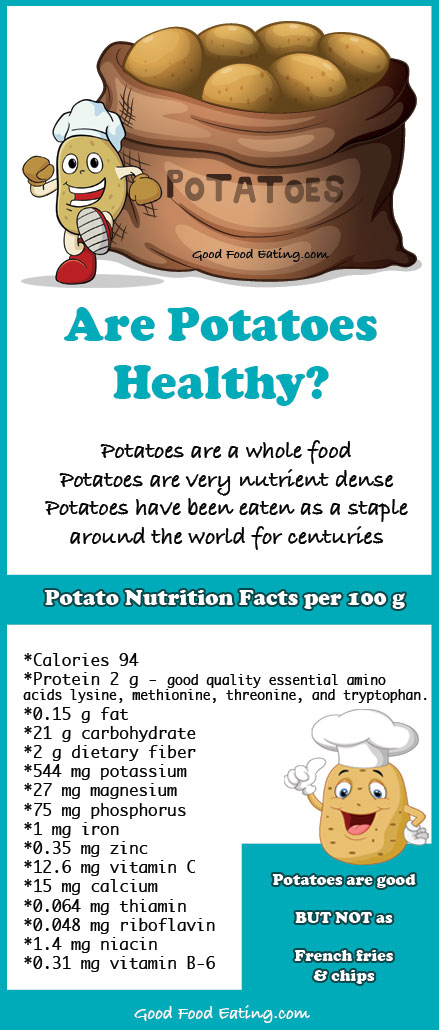
Per 100 g they have less energy than some of the other staple carbohydrates foods. For example: white pasta per 100 g provides 158 calories, white rice 130 calories, and the humble potato provides around 94 calories. The potato has got around 2 g of protein, 0.15 g of fat, 21 g carbohydrate, and 2 g dietary fiber.
When it comes to vitamins and minerals the humble potato packs quite a punch and is one of the highest vegetables in potassium and magnesium. It has 544 mg potassium and 27 mg magnesium, it also has 75 g phosphorus, 0.64 mg iron, 0.35 mg zinc, 12.6 mg vitamin c, and 0.21 mg vitamin B-6. And the great thing about potatoes is the vitamins and minerals are absorbed really well.
In fact potatoes are so nutrient dense that they have been used to save lives!
That’s right.
Potatoes have actually prevented complete starvation in many countries and have also been used to sustain malnourished populations.
In a study where they were testing if potatoes could sustain and restore malnourished children, researchers discovered that diets providing 50-75% of total energy intake from potatoes could adequately support normal growth in children and maintain normal protein levels in the blood.
What the study showed was that the protein level in potatoes was enough to sufficiently support children to grow and it also showed it was enough to maintain body weight in adults as well. Of course this is in third world countries where other food is lacking. Still, this was important research because they discovered that the protein quality of potatoes is quite high, as it hosts 4 of the top essential amino acids that provide the most benefits. These are lysine, methionine, threonine, and tryptophan. So although there is only 2 g of protein in 100 g of potato, it is good quality protein.
I really found that quite interesting.
Potatoes are mainly carbohydrate, making up 95% of the vegetable. They contain amylose and amylopectin in a 1:3 ratio. Amylopectin is a branched chain starch and allows a greater digestibility than the amylose and it’s the amylose component in starches that has been associated with a higher glycemic response, meaning it raises your blood sugar faster.
Amylose is a resistant starch, meaning it’s unavailable to the body when raw. But when we cook resistant starch it changes it’s structure and increases its solubility. When potatoes are cooked and then cooled they undergo a process known as retrogradation and this causes the starch to become more crystalline and increases its resistance again. the reason this is important is that resistant starch feeds bacteria in our large intestine and those bacteria create byproducts called short chain fatty acids that are beneficial for our health. So that means that cold potatoes like you’d find in a potato salad do not raise blood sugar as much as hot potatoes. It’s because of this resistance starch thing that this occurs.
So is a potato healthy?
Well let’s think about obesity, diabetes and potatoes for just a moment.
In the Western world it’s true that many children know very few vegetables. I find this quite disturbing but many kids honestly can’t identify vegetables. But everyone, including very small children knows what a potato is. While the humble potato has been blamed for obesity and diabetes, is this really the case?
Well, it is evidently clear that french fried potatoes, and potato chips, are not a healthy way to enjoy potatoes. And consumed like this in large amounts they certainly could contribute to the problem of obesity and diabetes. It is also not fully understood if it’s the potato or the cooking method. And I’d be fair to bet that it’s the cooking method and more importantly the type of oil they are cooked in. I talked about Omega 6 pro-inflammatory oils recently in episode 71, and it is a well known scientific fact that cheap vegetable oils increase inflammation, and increased inflammation can cause obesity and diabetes. So is it really the humble potatoes fault?
I doubt it because there is very little scientific evidence that potatoes contribute to weight gain. Several studies have shown that potatoes themselves show no relationship at all to increased risk of type 2 diabetes. So it stands that the humble potato has been accused wrongly in this instance.
In fact potatoes might provide great health benefits we don’t even know about.
For instance, there is some research available that shows that increasing potassium in the diet can help lower blood pressure and risk of stroke, so could the humble potato be a way for people to eat a high amount of potassium, well perhaps they could be?
We are just speculating here because no study like that has ever been done.
When it comes to satiety and feeling full, potatoes are ranked the highest compared to other sources of carbohydrates such as bread, rice and pasta, this includes wholemeal sources as well. So clearly, people favor potatoes over most other things.
As far as glycemic index goes potatoes range from being on the borderline to medium high, to very high. This all depends on how the potatoes are cooked and interestingly it also depends on what type of potatoes you are eating.
I checked out the glycemic index of potatoes at GlycemicIndex.com which is a site created by the University of Sydney and they have tested lots of foods and their glycemic index and load. You can check that site out yourself at GlycemicIndex.com
Glycemic Index of Potatoes
So let’s go through the glycemic index of potatoes and different ways it is cooked.
For each instance we are talking about 150 g potato.
• Baked potato with skin has a GI of 69, GL 19
• Baked without the skin GI 98, GL 26
• Instant mashed potato GI 88, GL 18 – I don’t know why you’d want to eat that stuff but some people do so I thought I’d include it.
• Boiled potato GI 96, GL 24
• Pontiac potato, peeled and boiled whole for 30 minutes – GI 56, GL 14. Now that’s pretty low but if Pontiac potato is boiled for 35 minutes instead of 30 this increases the GI to 88, GL 24, which is quite a substantial increase for just an extra 5 minutes of cooking.
• Potato crisps range from GI 51-60 – which is actually quite low and that is likely because of the fat but remember that’s not a cook thing in most cases.
• New canned potatoes GI 65, GL12
• Mashed potato has a GI 71-73 ,GL 14-15, avoid desiree mashed potato because they have a GI of 102.
New potatoes are around GI 80 boiled
• Steamed potato GI 62, GL 12
• Potatoes boiled then cooled in the fridge, then reheated have a GI of 23, GL 8
• Red potatoes boiled then refrigerated GI 56
So after all that where do we stand with the humble potato?
Are potatoes healthy?
Yes potatoes are healthy.
Potatoes are a whole food source that has even been shown to sustain life itself.
Potatoes are very nutrient dense.
Potatoes are loaded with vitamins and minerals.
Potatoes are affordable.
And let’s face it, we all love potatoes!
Top 4 Healthy Ways To Eat Potatoes
But what the glycemic index reveals is that the Top 4 healthy ways to eat potatoes are:
1. Steamed – steamed potatoes have a moderate glycemic index of 62 and a glycemic load of 12.
2. Boiled and cooled potatoes. So eating a potato salad is a great way to eat potatoes. And you could even try steaming potatoes and cooling them, perhaps that lowers the glycemic index even more? Don’t quote me on that one because I couldn’t find the stats but it makes sense that if steamed potato has a GI of 62 and boiled up to 96 then steaming and cooling would be better. That’s my logic anyway.
3. Cook the potatoes, refrigerating them, and then reheat them.
4. Baked potatoes with the skin.
Now I’m not saying go crazy on potatoes. Not by any means. We still need to watch our carb intake and make sure we eat lots of fibrous carbs, meaning eat more veggies and salads.
And you certainly don’t want to be eating any kind of potato has browns or fries at fast food outlets. And that goes equally the same for fish and chip shops or restaurants because most likely they will be serving chips deep-fried in cheap vegetable oil.
But if you do want a French fry or a crunchy chip from time to time then there is nothing wrong with making some homemade ones, baked with the skin on in a little olive oil or coconut oil. We do this ourselves from time to time and they are great.
So eat your potatoes, just eat them the right way, which is steamed, boiled and cooled, cooked, cooled and refrigerated and then reheated, or baked with the skins on. So that gives you lots of options to include potatoes in your healthy diet routine.
But just remember; don’t just eat potatoes. Eat lots of other veggies too!
So thanks for being here and sharing the ins and outs of the humble potato with me today.
Take care and I will be seeing you soon.
Jedha
Nutritionist & Health Coach


Connect with us!