
Turmeric has an active component known as curcumin, a powerful antioxidant that helps with loads of things and in this podcast I share some of the benefits, along with answering the question about side effects.
- What is turmeric
- Does turmeric work for reducing inflammation
- What things does turmeric help
- Tips on using turmeric for cooking
- What supplements are best to take
- Are there any side effects from taking turmeric
LISTEN
READ
Hello and welcome back to the GFE Podcast. We’ve got a Food Facts podcast.
And the food of interest on today’s agenda is Turmeric.
Well it is actually a spice and a very interesting one at that. It’s an Indian spice that has been used for centuries in Ayurvedic medicine so that’s already saying something right? If you’ve never heard of Ayurvedic medicine, it’s the ancient medical practice used in India for more than 3000 years. I think traditional medicines used in places like India and China have a long and valid history and many of their practices are based on using herbs, spices, special diets, and natural therapies, which is really interesting. So turmeric is one of those spices that has a very long history of use.
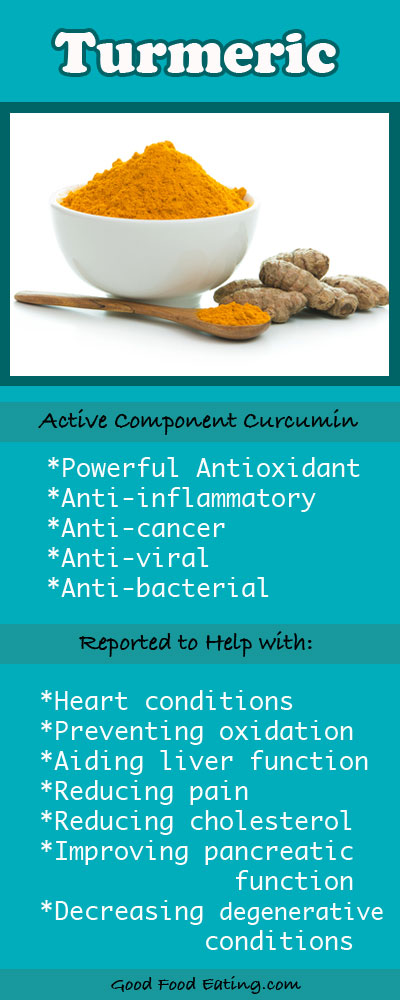
Turmeric has also found a very solid footing in modern medicine. Turmeric contains over 300 different components but one of the most beneficial components is called curcumin. It’s this component that has been associated with having various antioxidant, anti-inflammatory, anticancer, antiviral, and antibacterial activities. Curcumin is a very powerful antioxidant and affects key signalling molecules in the body.
A study I was reading in the Cancer Research Treatment Journal stated that there have been 100 clinical studies on curcumin and over 6000 citations, meaning it’s also mentioned in many other studies as well. So it’s probably one of the nutrients or spices that has been studied much more than many others.
So does turmeric work for reducing inflammation?
Yes it does.
In fact it has been reported to help with ALL kinds of inflammation and in a study by the Cancer Research Foundation?? it is reported as second on an anti-inflammatory index, the first being magnesium.
In the studies I’ve looked at turmeric has been reported to help with:
- heart conditions
- preventing oxidation
- aiding respiratory issues
- aiding liver function or issues – so this could help with diabetes and weight loss
- improving pancreatic function
- decreasing the rate of degenerative conditions and improving the symptoms associated with them
- reducing pain symptoms
- and reducing cholesterol
Back in episode #32 of the GFE Podcast I talked about how fat tissue is a very metabolically active tissue that produces many pro-inflammatory molecules. Amazingly, it has been discovered that turmeric reduces the inflammatory response in fat tissue and helps promote fatty acid oxidation. What it does is it exerts an anti-inflammatory effect on our immune cells known as macrophages. These are key immune cells that are often responsible to recruit other immune cells and increase the initial inflammatory response that occurs. That means turmeric is great because it’s stopping the macrophage cells from releasing pro-inflammatory molecules and upregulating inflammation.
Human studies have also shown that turmeric taken at 1-4 g a day has a positive effect on cholesterol levels, decreasing total triglycerides, lowering LDL, and raising HDL. Research in the area of cholesterol and turmeric is still being undertaken but initial research does look promising.
Turmeric For Eating and Cooking
So turmeric can be bought as a dry spice, if you’ve never seen it, it’s a bright yellow powder and it’s so strong it can actually be used to dye cloth, so don’t touch your clothes if you’ve been using it or you might just find you’ll have a nice yellow stain. You can also buy the turmeric fresh at the store, it looks like a yellowish, orange root and if you’ve ever seen ginger, it has a similar resemblance to ginger except it’s a different color.
Many studies suggest that the bioavailability of turmeric is quite low, with only a small amount of it reaching the bloodstream.
For example: one clinical trial in women who had low grade inflammation were given 2.8 g/ day, eaten in culinary doses and at the end of the trial there was no difference to inflammatory markers.
So if you are using it in cooking it might only provide a small benefit. But that doesn’t mean it provides no benefit and I’d still recommend using turmeric in cooking and teas because small amounts on a more frequent basis accumulate and do provide many benefits.
Turmeric can be used from the fresh root and grated into cooking, teas, and dishes. While the powdered form can be included in curry mixtures, cakes, scones, and much more. Either form will provide powerful anti-inflammatory benefits.
Try this easy turmeric tea recipe.
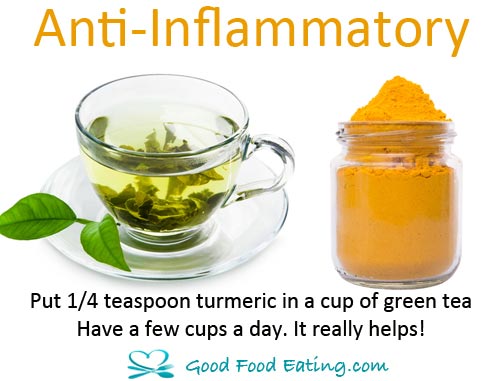
Put 1/4 teaspoon of turmeric powder in a cup of green tea and drink a few cups a day. Both the turmeric and the green tea are anti-inflammatory and make a great combo and if you don’t drink green tea, try it in chamomile or even a lemon tea and it will be great too.
I use lots of turmeric when making a laksa. A laksa is a coconut curry soup, it’s mild but it’s super delicious. I also make my own curry mixtures and they contain lots of turmeric. Use some powder in soups, casseroles, or even scones. In fact, give it a try in whatever you can. I don’t think it has an overpowering taste, perhaps a little bitter but when combined with other flavors you can’t taste it all that much, so be brave and give it a try.
So what about turmeric supplements?
One way to get the full benefit of turmeric is to take it in a supplement form because they have managed to find a way to improve it’s bioavailability by encapsulating the curcumin in liposomes.
Liposomes are bilayer (double-layer), liquid-filled bubbles made from phospholipids. In studies it has been shown that taking it this way has a faster and more effective absorption rate. So when looking for supplements look on the label to see if the turmeric is wrapped in phosopolipids. Where the supplement says it contains a high level of curcuminoid, for example it might say 95% curcuminoid, this is a good thing and virtually means the same thing because what it means is the turmeric has been modified to make the curcumin more soluble and more bioavailable to the body.
Another tip is to look for turmeric supplements that contain black pepper extracts because that has also been shown to aid absorption.
Turmeric Supplements I Recommend
As for how much to take, take 500-600 mg twice a day or as recommended on the product label because they will all be different.
Are there any side effects to turmeric?
There are currently no reported side effects of taking a turmeric supplement.
Human clinical trials have shown that it is safe to take up to 8 g/day, which is about 8000 mg and most supplements only contain around 500-800 mgs so at the recommended dosage they will generally be safe to take.
However, People with gallstones or gall bladder issues should not take turmeric, nor should pregnant women. And if you are taking medications of any kind, it is always advised that you check with your doctor or health practitioner for any contraindications.
So that’s the run down on turmeric. It has loads of benefits for health and is excellent for helping to reduce inflammation. A vey powerful antioxidant that I’m sure we’ll continue to hear more about as the research unfolds.
Thanks for joining me. Take care and see you in episode number 77.
Bye now.




Thanks for the information. I had no idea that turmeric was such a versatile and helpful spice. Since turmeric is an anti-inflammatory, does it help with menstrual cramps? My sister gets really bad ones, and most things don’t really help.
Hi Virginia, It can help with menstrual cramps, but magnesium helps the most. I discovered this years ago from my chiropractor, we lose more magnesium when we menstruate. All you need to do is take a dose of magnesium powder and within 20 minutes the cramps should dissipate. Magnesium also helps lots of other things too and is a powerful anti-inflammatory. Here is some more info on benefits and choosing a supplement http://goodfoodeating.org/844/best-magnesium-supplement/