
This diabetic carb couting tutorial is part of our T2 Diabetes Nutrition and Health Series covering a whole range of topics. So be sure to click on the image to subscribe to the series 

We’ve got a short video tutorial to show you just how easy it is to count carbs or you can also read the video transcript below.
Diabetic Carb Counting Video Tutorial
Extra Resources
VIDEO TRANSCRIPT
When it comes to managing your diabetes, carbohydrates are the main food to focus on as these have the biggest influence on blood sugar.
It can all get confusing but just think of carb counting as a method of meal planning. It’s a way to keep your blood sugar even throughout the day, and lower blood sugar or A1C if it’s currently too high.
We’re not going to cover how many carbs to eat in this tutorial, so please click here for some info on how many carbs to eat.
In this tutorial we’re just going to cover how to count carbs.

Two Ways To Count Carbs
There are 2 ways to count carbs and they are both easier than you think. Of course it does take a bit of time to get used to but overall it’s not that hard.
These are grams of carbs or carb choices – they are essentially the same thing but counting grams of carbs is more accurate than carb choices.
Let’s look at carb choices first
Carb Choices
1 Carb Choice = 15 grams carbohydrate – what one carb choice really means is one serve of carbohydrate because one serve has approximately 15 grams of carbohydrate.
So let’s look at some examples of 1 carb choice:
- 1 slice bread
- 1/2 cup rice
- 1 small piece fruit
- 1/2 cup beans or lentils
- 1/2 cup corn
- 1/2 cup mashed potato or sweet potato
- 1/2 – 3/4 cup cereal
- 1/2 cup cooked cereal
So here is an example of how to use the carb counting method.
You will have to get familiar with reading every food label. What you want to look for is the total carbohydrate per serving, also take note of the serving size listed at the top so you know how much of the food item is one serving.
It is very easy to consume more than one serving if you are just trying to guess because our idea of portion sizes is often much larger than the actual portion sizes recommended on the package.
As you can see in this example there is a total of 30 g of carbohydrate, so if one carb count is 15 g and we multiply that by 2 we get 30 g, that means you have 2 carb choices in one serve of that food item.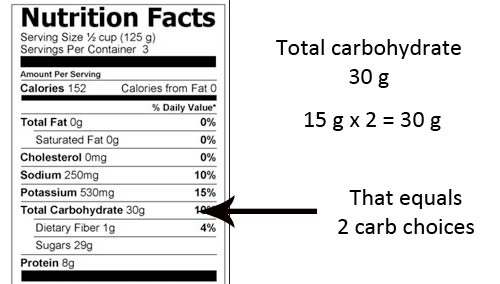
It’s VERY important to focus on choosing quality carbohydrates and the best source of carbs is vegetables.
Choose lots of vegetables because vegetables are also a source of carbohydrate, especially non-starchy vegetables such as broccoli, asparagus, cabbage, cauliflower, tomato, lettuce, cucumber, bell pepper, zucchini, because these only contain a very small amount of carbs and generally don’t increase blood sugar.
They also contain loads of fiber, and the vitamins and minerals you need to help improve your overall health.
Couting Grams of Carbs
Counting grams of carbohydrates is more accurate.
It’s still important that you take note of the serving size. Remember our idea of portion sizes is often much larger than the actual portion sizes recommended on the package and could easily push your blood sugars up if you overeat.
Now you want to take note of 2 things, the total carbohydrate and the fiber content because we are going to calculate net carbs.
To calculate net carbs we take the total carbohydrate and minus the fiber content. So in this example the fiber content is only 1 g so the total carb count is still 29 g.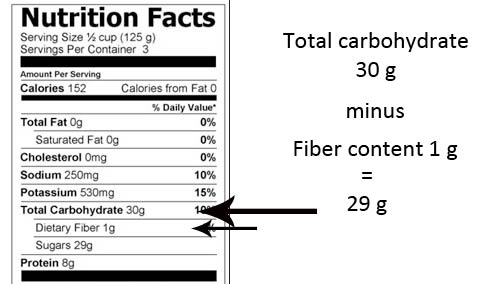
Fiber does not contribute to blood sugar or cause insulin spikes so it does not count toward carbohydrates when you are counting in grams.
Let’s look at another example.
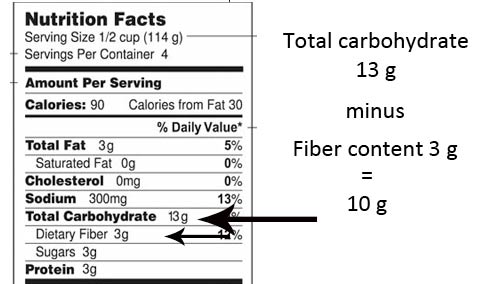
In this example we have 13 g total carbohydrate and 3 g fiber, so if we minus the fiber from the total carbs we are left with 10 g net carbs.
So you add up your net carbs for the day to get your daily carb amount or your per meal carb amount and this helps you to do some meal planning in order to manage your blood sugar better.
I want to emphasise again the importance of choosing lots of vegetables because they are the best source of carbohydrates and they contain a low amount of net carbs.
This means you can fill up on them, get valuable nutrients and be improving your health at the same time.
There is a low amount of net carbs in vegetables so when you choose mostly vegetables, you will still get adequate carbs in your diet but you won’t have to think so much about carb counting.
I hope this short diabetic carb counting tutorial shows you just how easy it is to count carbs
Jedha
Nutritionist & Health Coach



I have been having a hard time lately staying on track. I am type 2 no meds, but I am heading in that direction. Thank you for posting this as it has given me the emotional boost I needed to get back on track. Thank you <3 No need to follow up I know you are busy.
Hi Kathleen, it definitely can be tough for us all, so I hope you’re feeling better.
Have you checked out my new Diabetes site? You’ll find tons of helpful resources there https://diabetesmealplans.com/diabetes-resources/
I hope to see you over there, and feel free to leave comments for a boost at anytime.