
In today’s podcast we cover some more info about one of my favourite topics, inflammation!
We cover:
- How inflammation is related to many conditions other than arthritis
- What inflammation is and how it occurs
- What we can do to reduce inflammation
- The foods to focus on to get started on the right track
Get Involved In The Challenge! Leave Your Comments at The End of The Post 
TRANSCRIPT
Hello and welcome back to episode #60 of the GFE podcast. On today’s podcast we are going to dig into the topic of inflammation again and answer a question that I received recently. ‘What is inflammation exactly?’ so we’ll be digging into that shortly.
So here we are at Number #60 of the GFE Podcast and for some reason that feels like another milestone to me. When I first contemplated getting this podcast going, it was just that, contemplation.
I think it took me about a year or so before I actually got around to putting it into action so it’s great to get 60 episodes in and say that I really enjoy doing these podcasts.
 What I love about it the most is hearing from you, that inspires me to keep going because I know that you are driving to work listening and soaking up information to inspire and motivate yourself into positive action. Or you might listen at the gym, on your walk, or wherever you may be. I think that podcasts are a wonderful medium for us to connect. So thanks for being involved and I can assure you we’ve got plenty more to come.
It probably feels like a milestone to me because I’ve just finished another milestone as well, the completion of my Masters thesis. It’s such an awesome feeling to get to those milestones, things you work towards and achieve. I also got some great news. I submitted an abstract of my research to one of the big nutrition conferences and I got selected to do a presentation of my work at the conference in November. I actually didn’t think I would because there were around 200 abstracts submitted, but I got a very nice surprise when I received the email. Actually I was more than excited, and I can’t wait to go and present it.
The great thing is I’m hoping to meet some other great researchers at the conference and I intend to interview some of them while I’m there because I would love to share some of the latest nutrition research and knowledge with you. So you can look forward to hearing some of those interviews later this year and I’ll also be sharing my experiences and journey to the conference.
We’ve also got some other exciting things coming up for Good Food Eating, I mentioned we’ll be opening the Good Food Eating Virtual Nutrition School on the 26th October so I’m really excited about that as well. This is another thing I’ve been wanting to bring to life for a very long time so I’m looking forward to sharing more info about that very soon.
We are also going to be starting a new video podcast soon that is going to show you how to cook certain things and also how to choose and swap out foods for other things. I think there are just some things that need to be visual so we have decided to make a short weekly video podcast and it will also be available in itunes, so I will let you know about that when it becomes available so you can subscribe to that as well.
Anyway, that’s enough about what’s going on this side of town, let’s dig into today’s topic of inflammation. So what is inflammation exactly?
That’s a great question because when I mention the word inflammation people commonly think of arthritis or maybe back pain but it’s not something we think could be related to food, or depression, or weight gain, or type 2 diabetes, or cancer, or heart conditions, or various other conditions, right?
That’s because we are all aware that arthritis is an inflammatory condition, it’s pretty common and most of us are aware of it. Where as the concept of inflammation being involved in the development of many conditions is not commonly talked about. In fact there are likely thousands of doctors and health practitioners who are still clueless about it.
I talk about it a lot for this reason, and it happens to be the topic of my thesis and it’s also a topic I’m passionate about. The reason for this is that if we can reduce inflammation in our body’s we can prevent many conditions from arising. We can also improve many conditions, lose weight, get healthy and feel great and they are all pretty good motivators to me, wouldn’t you agree?
But what is inflammation exactly and how is it related to so many conditions?
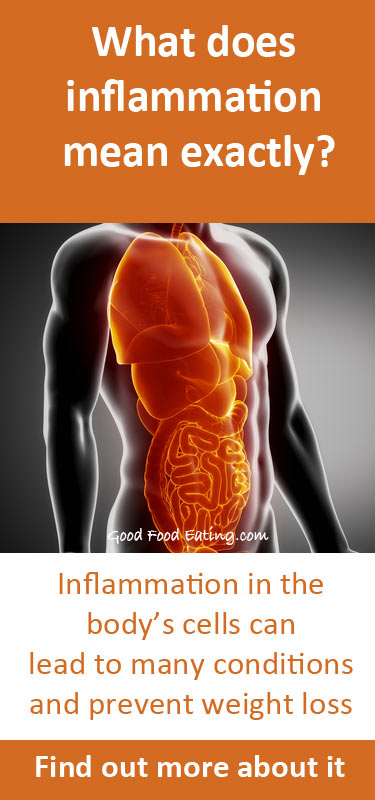
Inflammation is essentially a response of your immune system. It’s a normal process and one of the best ways to imagine it is to think about when you get an injury like a cut. You’ll notice the cut gets red and swollen and this is your immune system responding to the cut. Your body naturally sends in different types of immune cells that will assist with healing the wound. So an inflammatory response from the immune system is a normal and natural reaction. Once the wound is healing, then the immune response calms down.
This type of immune response is occurring inside our bodies all the time. Our body is always doing a balancing act fighting various inflammatory and immune stimulants that we come into contact with. These can include the food we eat, all the chemicals we come into contact with and breath in, and even stress because it causes reactions in our body.
Inside our body we have a whole range of immune cells, some of these are called cytokines and cytokines are cell signaling molecules that act as communicators in the immune response. If these cytokines sense that something is foreign to the body they initiate a reaction and start recruiting a whole range of immune cells and essentially what occurs is an inflammatory reaction inside your body’s cells.
It’s the same concept as we talked about with the cut but it’s happening on the inside of your body where you can’t see it. And with all the changes that have occurred in our lifestyle our bodies have become overloaded and many of us are now in a state of constant low-grade inflammation. This is where the body’s immune response is not being switched off because we are constantly being exposed to various inflammatory stimulus that keeps provoking this immune response.
As this process continues the cells in our body actually start to change, for example, let’s talk about how this process might occur in relation to heart conditions. So in response to inflammatory stimuli the artery wall called the epithelium can become damaged, this initiates that immune response and various immune cells come into action, but the vascular smooth muscles in the artery wall start to change, they migrate, multiply, and produce more pro-inflammatory molecules and this changes the structure of the artery wall, lesions begin to develop that can eventually lead to heart attack or stroke.
The important point here is the changes that occur in the cells themselves. Now think about cancer, it’s a process of cell growth and migration. Can you now understand how inflammation in the body’s cells could drive this to occur?
It’s essentially the same for type 2 diabetes where a whole range of cell changes occur in the body, and with weight loss, depression, and various other conditions I haven’t mentioned here. Research is pointing to inflammation as being involved in the development of nearly every condition. Since we now understand that this is a response of the immune system we can now understand why.
The reason why more and more people are getting sick, can’t lose weight, and feel plain lousy is because they are in a state of low grade inflammation due to our modern lifestyle. The foods we eat are unnatural, the environments we live in full of chemicals are unnatural, the amount of stress that we are often subjected to is unnatural. Many of us don’t get enough sleep and relaxation and all this contributes to the inflammatory stimuli that creates this immune response.
So what can we do about it?
We can actually do a lot and one of the best places to start is with the food you eat. The food we eat can modulate our immune response and help reduce inflammation. Our digestive tract, so that’s inside our intestines, hosts about 70% of our immune system and it’s where a lot of this immune response gets initiated.
What our body needs to fuel all of its cellular functions are nutrients, vitamins, minerals, compounds like polyphenols, fibre, and so forth. But our modern food supply does not contain any of these nutrients we need. Processed and packaged food is mostly void of nutrients and therefore it acts as an inflammatory stimulus. Our body is intelligent enough to know this and can detect when something is foreign to the body.
In our digestive tract a whole range of things occur, different hormones and chemical compounds are produced in our digestive tract, foods can initiate inflammation, and changes can occur to the mircobiome in the digestive tract. The microbiome are our gut bugs, the bacteria that live inside our digestive tracts that are there to help process the food. But there are good bacteria and bad bacteria and these are also involved in immune response, hormone production, and cell signaling as well.
The topic of gut bacteria and immune development is a whole topic in itself so we won’t dig into that now. But just know that the food we eat is having a major influence on every single process that occurs in our body.
We can regulate our hormones through the food we eat, we can reduce inflammation through the food we eat, we can influence our gut bacteria through the food we eat, we can prevent conditions through the food we eat, and we can support our immune system through the food we eat.
This is perhaps one of the most important and powerful things, is that just by changing our diet we can influence so many things. Reducing inflammation in the body can improve your health on so many levels and you can reduce inflammation in the body in a matter of weeks.
How?
Don’t eat processed foods. Focus on eating natural real food, food your great grandmother would recognize back in the 1900s and trust me that was not anything like McDonalds and supermarkets weren’t lined with thousands of ingestible ‘products’. That’s the very first step in changing all of this, is to cut out as much of that processed and packaged stuff as you can.
I know it may not be easy to do and that you even might have no idea where to start or how to do it. That’s why I’m here to help you. All of the nutrition info I share here on the GFE podcast will help you reduce inflammation and start making these changes. Because I know it can be difficult for people our new video podcast is going to show you how easy it is to take these steps. And if you still struggle, the GFE Virtual Nutrition School is going to be there to show you exactly what to do and will provide the extra support you need to do it if that’s what you need.
At the end of the day it is up to you to take some action. Don’t just listen but think about what you could change, think about how you could change it and start with just one thing. In fact I’ve got a simple challenge for you, think about one thing you could change in your diet and daily eating routine that would make a difference to your health, just one thing.
What are you going to do to change it right now?
I’ve just decided this on the spur of the moment but here’s what we’ll do. I want you to take some action so go to GFE.com/60 and share the one thing you are going to work on changing in the next 7 days and also share how you are going to do that. Choose a food to reduce, a habit to change, something that will make a difference to your health. Share it with us and how you might go about it over at GFE.com/60. If you’re not sure how to go about it I will help to offer some suggestions on how you might get started or some tips to make it easier. And for those of you that get involved perhaps you can provide tips for others as well.
I’m also going to give you an incentive for taking action. I will give away 2 months of free access to the GFE virtual Nutrition School opening on October 26th to 2 luckypeople who take some action on this. So that’s 2 free passes to the GFE Virtual Nutrition School for 2 months. So if you take some action and go and share you could also win. I’ll choose the 2 winners on the 17th October and notify you be email so you’ve got until then to come and share. Of course you can still come and share after that but you just won’t be in the running to win a free pass to the GFE Virtual Nutrition School.
Now we all love to win something and I don’t really want to bribe you but what I want you to do is take some action.
Start reducing inflammation, start getting healthier, or if you’re already started then come and tell us what the next step is for you because there are always areas for improvement.
I hope you have enjoyed today’s podcast and now understand exactly what inflammation is all about. Of course if you have more questions about inflammation I’d be more than happy to answer them so feel free to come and share those over on Facebook or via the GFE website.
And be sure to get involved in our challenge. Head over to GFE.com/60 and share the one thing you are going to work on and how you are going to do that in the next 7 days.
THE CHALLENGE
2 x 2 month free passes to the GFE Virtual Nutrition School up for grabs!
Leave your comments below.
Share the one thing you are going to work on and how you are going to do that in the next 7 days.



Focusing on getting more greens into my diet. One thing I’ll be aiming for: a green smoothie each day.
My husband and I are starting small and going to do 5 push ups every day and not eat past 8pm. We’re both SO tired of being overweight and out of shape but we’ve realized that when we put ourselves on a regimen that’s too difficult or too strict, we simply bail on it after a few days. Small steps is what we’re working on now! Very small, attainable goals that we can expand on!
Intentionally plan more vegetables into every meal.
I love the idea of taking this slow, and keep moving in the right direction. The last 30 days I stopped eating process foods. Which for now is not eating out at fast foods or dinning out.
I’m feeling so much better and dropped 10 pounds.
My one thing is drinking a mixed green juice one time a day. I’m not getting enough greens in my diet and till I find what I like, this seems to be working.
I can tell my taste buds are changing all ready.
I am going to work on planning my meals.
I have the week from hell coming up with four lots of 14-15 hour work days as we deliver our school’s musical production.
I am mapping out breakfast/lunch and dinner as well as snacks for each day.
I am also going to prep as much of these meals as I can in the hope that I can eat and feel better (generally its no eating or the nearest fast food during production week).
Just thinking about having it all planned is making me feel more positive for a great week!
I need to work on getting more vegetables into my diet. I usually gravitate more towards fruit, but I’m going to make a conscious effort to include more veggies.
Hi Jedha,
I recall a Q&A podcast that planning or changing one meal a day is a good place to start. I have been running 3 times a week successfully for a while now. I have run a 5k race and have a 5k and 10k planned in the near future. However, my weight loss has halted and I’m convinced that improving my diet, habits and perceptions about food is the next thing to focus on.
My plan for the next week is to start with breakfast. I will cook a wholesome, natural breakfast every day for the next 7 days. One of my new favorite breakfasts is a vegetable frittata recipe from the Good Food Eating website. I will definitely cook a few frittatas and probably all 7 breakfasts will be egg-based since eggs are so nutritious and versatile.
I can’t wait to hear more about the up-and-coming virtual nutrition school.
I have a coffee addiction, but it’s not just to the coffee… I fill my coffee with cream, splenda and either vanilla international delight or sugar free vanilla flavor.
I started today with only one coffee, which had less of the sweeteners than normal. (typically I have 2 very sweet coffees before 11). I’ve replaced my second coffee with a green tea.
My goal is that within 7 days, I’ll no longer be drinking coffee, I’ll have replaced with with water and green / herbal teas.